Recently, Japanese and Thai users have been arguing on X day after day.
X’s automatic translation feature is convenient, but it has also made it much easier for people from completely different cultural backgrounds to interact. In the past, these groups might never have crossed paths like this. Now they can, and that often leads to friction.
Language can be translated automatically, but cultural context cannot.
- The Incident at 7-Eleven
- As Someone Half Japanese and Half Thai
- Causes of the Conflict
- Thai Perspective: “Opening Before Payment Isn’t a Crime”
- A Real Case: Thai Tourist Arrested at Tokyo Disneyland
- Japan’s Strict Rule-Based Culture: Ownership Changes Hands Only After Payment
- Why Following Rules Maintains Social Order
- A Thai Question: “Why Are Japan’s Rivers So Clean?”
- Japan Was Also Polluted Until About 50 Years Ago
- Gray Bangkok, Blue Tokyo
- Differences in Regulation Compliance Between Japan and Thailand
- Which “Suffocating” Society Would You Choose?
- To Maintain Safety, Cleanliness, and Order, Individual Selfishness Has to Be Restrained
- Conclusion: Different Cultures Create Different Societies
- Final Note: The Good Points of Thailand’s “Tolerant” Society
The Incident at 7-Eleven
The controversy started with a video showing a Thai tourist pouring hot water into instant cup noodles at a Japanese 7-Eleven before paying.
迷惑系外国人、購入前のカップラーメンを勝手に開封
お湯まで入れてしまい店員さんガチギレ😱🦁Translation:
https://x.com/masanews3/status/2037871570836947127?s=20
A troublesome foreigner opens instant cup noodles before paying and even pours in hot water, and the staff was seriously furious😱🦁
The Japanese user who posted the video wrote that “the staff was seriously furious.” In reality, the staff was not angry. She was simply giving a polite reminder:
“(お湯を)入れる前に会計してくださいね。Please pay before adding (hot water,) okay?”
- 〜ください: please do ~
- 〜ね: a particle to soften the sentence
If we translate this into Thai, it would be “กรุณาชำระเงินก่อนใส่(น้ำร้อน)นะคะ,” a very polite way of speaking.
The person who posted the video seems to have been frustrated with what he see as an increase in “troublesome foreigners” in Japan, and likely exaggerated the situation.
As Someone Half Japanese and Half Thai
At its core, this should have been a simple moment of cultural awareness. They can realize rules differ from country to country. That should be the end of it. Instead, both Japanese and Thai users began insulting each other, which is unpleasant to watch.
As someone who is half Japanese and half Thai, I found the whole situation emotionally complicated.
I studied abroad in Thailand for a year and have traveled there many times, so I have some understanding of the culture. I want to explain why this kind of cultural friction happens. This time, I will mainly approach the issue from a Japanese perspective.
Causes of the Conflict
There are two main factors behind this conflict:
- Differences in how Japanese and Thai people think about rules and promises
- Thailand’s culture of sharing everyday life on social media
Different Attitudes Toward Rules and Promises
The biggest source of friction between Japan and Thailand is probably the difference in how people view rules and promises. In this respect, these two countries are almost opposites.
In Japan, some people get upset if a friend is even five minutes late. They see it as a lack of respect.
Personally, I have never liked that level of rigidity, and I tend to be more tolerant about time. But in Thailand, people can show up two hours late without much concern, and even I found that stressful at first.
Over time, I adjusted. I stopped trying so hard to be perfectly on time. When meeting Thai friends, I would bring my Kindle and wait at a nearby cafe if they were late.
I think I adapted fairly well. But Japanese people who strongly believe that promises must always be kept, the stereotypical serious Japanese type, often struggle in Thailand, where things do not always go as planned. One of my friends who studied abroad there even developed mental health issues. He was a very serious person.
To put it bluntly, many foreigners who end up loving Thailand tend to be people who dislike strict rules and do not quite fit into rigid systems in their own countries. In other words, they are a bit more “easygoing.” I might be one of them myself.
A Japanese person living in Thailand commented like this:
タイ人が日本のコンビニでカップラーメンのお湯を入れてから会計して注意されちゃったんだけど、タイではこれもオッケーなんで大目に見てください。
Translation:
https://x.com/PK76349649/status/2038081102494179617?s=20
A Thai person poured hot water into instant cup noodles at a Japanese convenience store before paying and got told off, but this is actually okay in Thailand, so please go easy on it.
This comment probably made “strict” Japanese users even more frustrated.
Thailand’s Culture of Sharing Everything on Social Media
Some Japanese users reacted angrily, saying “Why were they filming at the register in the first place? Were they trying to cause trouble for the staff?”
This reaction is understandable, but it is based on a misunderstanding. There are many Thai people, something I personally still cannot relate to well, who post even the smallest details of their daily lives on Instagram Stories throughout the day.
When they travel abroad, some of them would post updates every ten minutes. This is not an exaggeration. There really are people who share almost everything.
I used to have an Instagram account, but I could not keep up with that culture. The constant stream of posts and messages stressed me out, so I eventually deleted it.
The person who uploaded the video was probably just sharing a moment from his trip to Japan. He may have found the payment system interesting because it is different from what they are used to.
Still, this is a cultural habit that many Japanese people find difficult to understand. Personally, I also think that if the video had never been posted, this entire controversy would not have happened.
Thai Perspective: “Opening Before Payment Isn’t a Crime”
Ideally, this situation would end with a simple takeaway: rules are different in each country, so let’s be more careful next time.
The staff did not call the police and only gave a warning. Even so, some Thai users could not understand why Japanese people reacted so strongly, and their comments began to escalate.
พวกคนญี่ปุ่นก็ด่ากันเวอร์ชิบหายว่าเป็นอาชญากรรม อีบ้า ใครจะไปขโมยบะหมี่กึ่งสำเร็จรูปแดกทั้งๆที่ยืนรอหน้าเค้าเตอร์ ในไทยมันแกะใส่น้ำร้อนก่อนจ่ายได้ไง แค่เข้าใจกันผิดหรือเคยชินเฉยๆ ทีพวกมึงมาประเทศกูไม่รู้อะไรคนไทยพร้อมสอนอย่างดี พอคนไทยพลาดเล็กๆน้อยมึงด่าฉ่ำมาก งั้นกูขอด่ามึงบ้าง
Translation:
https://x.com/lazypoorasian/status/2037947418185200029?s=20
Those Japanese people are going fucking overboard, calling it a crime, fucking idiots. Who the hell would steal instant noodles while standing right in front of the counter waiting to pay? In Thailand, you can open it and pour in hot water before paying, it’s just normal. It’s just a misunderstanding or what people are used to, that’s all. When you come to my country and don’t know, Thai people are ready to explain things nicely. But when Thai people make even a tiny mistake, you guys go off on them nonstop. Fine, I’ll talk shit about you back too.
Well… Until a product is paid for, it legally belongs to the store. In Japan, opening something before payment can be treated as theft, and in some cases, people are actually arrested.
Strictly speaking, this would be also true in Thailand. In practice, though, stores just overlook it.
A Real Case: Thai Tourist Arrested at Tokyo Disneyland
There was in fact a real case in 2016 in which a Thai tourist was arrested at Tokyo Disneyland for opening and eating snacks before paying.

Getting arrested at the “happiest place on earth” sounds funny, but anyway, these cases indicate that many Thai people genuinely do not see opening an item before payment as a crime or serious problem.
From a Thai point of view, Japanese people may seem to be overreacting to what feels like a minor breach of etiquette. For Japanese people, though, this is not just about manners. It is a legal issue.
Japan and Thailand both drive on the left side of the road. But if you go to a country like US, where people drive on the right, you cannot defend yourself by saying, “We drive on the left in our country!”
For many Japanese people, this situation feels serious in that same way. The two countries are simply operating with very different assumptions.
Japan’s Strict Rule-Based Culture: Ownership Changes Hands Only After Payment
When I was in middle school, I did a short work experience placement at a home improvement store and helped the cashier.
I tried to bag items quickly and hand them to customers as efficiently as possible. The cashier said to me “Please hand the items to the customer only after the payment has been completed.”
At the time, I remember thinking, “We’re going to give it to them anyway, so what difference does it make?” But in the moment, I also understood that ownership transfers to the customer only after payment is complete.
Why Following Rules Maintains Social Order
At first glance, rules like this can feel tedious. In reality, they are quite rational.
For example, if an item placed on the checkout counter is stolen, who takes the loss, the store or the customer? Situations like this are much easier to handle when ownership is clearly defined at every stage.
The same logic applies to the convenience store case. If someone pours hot water into the noodles and then realizes they do not have enough money, it creates an unnecessary problem. If the item has not been opened, it can simply be put back on the shelf.
Rules may seem inconvenient, but they are designed to prevent more serious trouble from happening in the first place.
A Thai Question: “Why Are Japan’s Rivers So Clean?”
These kinds of small rules accumulated over time, have shaped Japanese society. I once had a memorable conversation with a Thai person:

I’ve been to Japan. Why are the rivers so clean?
Hmm… I’m not sure. In Japan, clean rivers are just normal…
Actually, why are rivers in Thailand so murky?
Hmm… I don’t know either, haha
For me, a young Japanese growing up in Japan, clean rivers were simply the default. I never even thought of them as “clean” because that was just how things were.
In Thailand, on the other hand, many rivers are brown and murky. There has even been a case where a person fell into a canal, developed a bacterial infection that spread to the brain, and died.

For Japanese people, the idea of falling into a river and dying from an infection is almost unimaginable. When I first heard about that, I was shocked. I often rode boats along canals in Thailand, and every time, I found myself thinking “If I fall in, I might actually die.”
It was only after living in Thailand that I realized clean rivers are not something we can take for granted.
Japan Was Also Polluted Until About 50 Years Ago
That conversation reminded me of what Japanese students learn in school about past pollution problems. From the late 1950s to the 1970s, Japan experienced four major pollution-related diseases:
- Minamata disease: caused by mercury-contaminated industrial wastewater
- Niigata Minamata disease: also caused by mercury pollution
- Itai-itai disease: caused by cadmium from mining operations
- Yokkaichi asthma: caused by sulfur oxide emissions from petrochemical plants
All of these were the result of rapid industrialization during Japan’s period of high economic growth. Just 50 years ago, Japan’s rivers and air were polluted enough to seriously harm people’s health and even cause many deaths.
So why are they clean now? Because the government built proper sewage systems, introduced strict regulations, and companies complied with those rules.
If Japan were not a rule-based society, its rivers and air would likely still be far more polluted today.
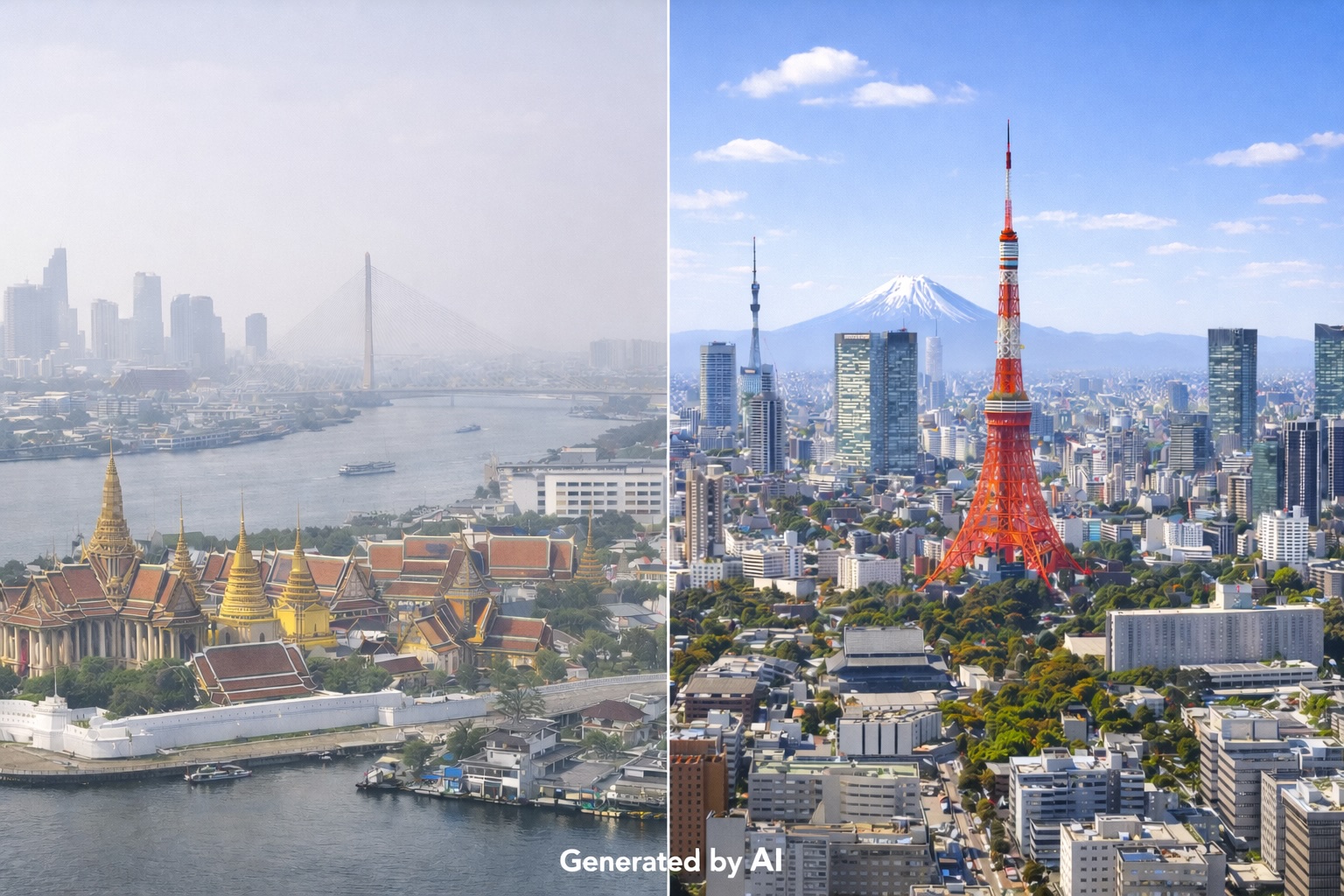
Gray Bangkok, Blue Tokyo
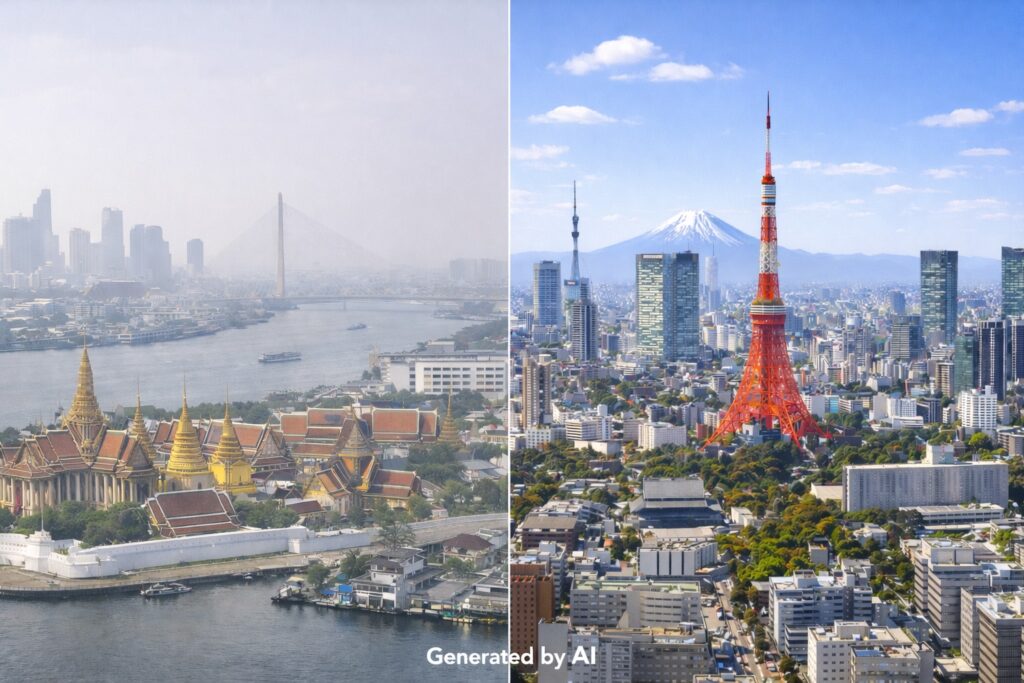
The color I associate with Bangkok is gray. The buildings are gray, and the sky is often covered in a dull haze because of air pollution.
When I was studying abroad, I went back to Japan for a short visit. After taking the bus from Narita Airport and arriving at Shinjuku Station, I noticed the sky in Tokyo was a clear blue.
It was the first truly beautiful blue sky I had seen in a while. At the same time, I was struck by the fact that such a sky could exist right in the middle of a huge city like Tokyo.
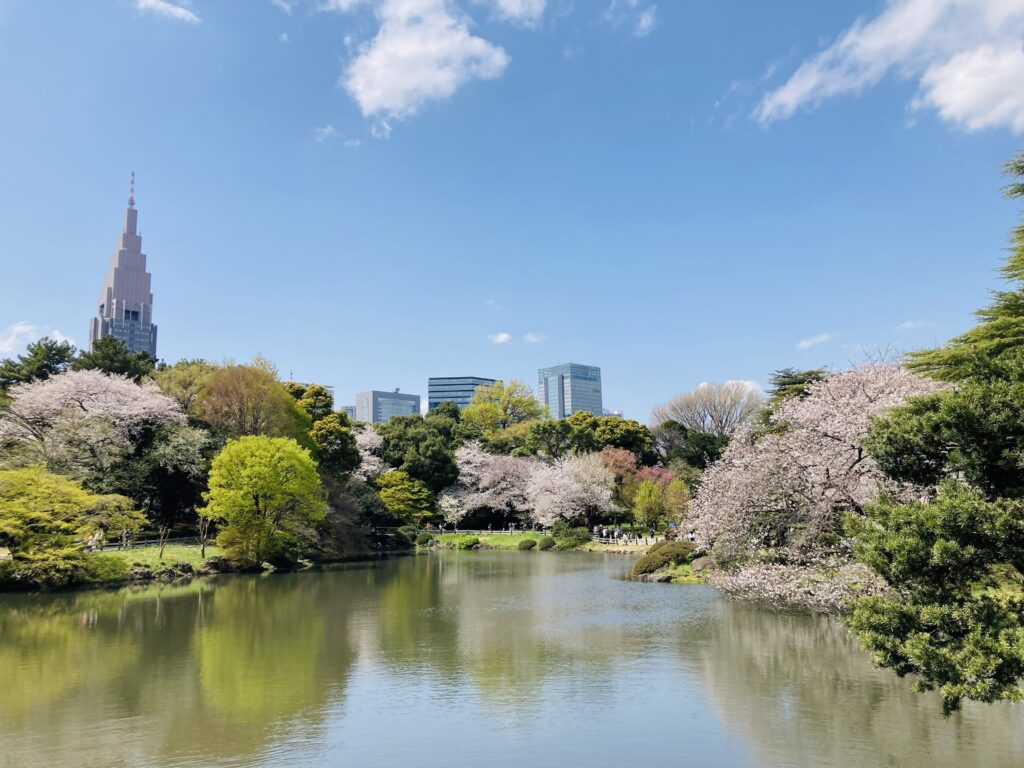
Ironically, I once felt suffocated by Japanese society and left it behind in search of something else. Yet when I returned, I was greeted by a wide, open blue sky.
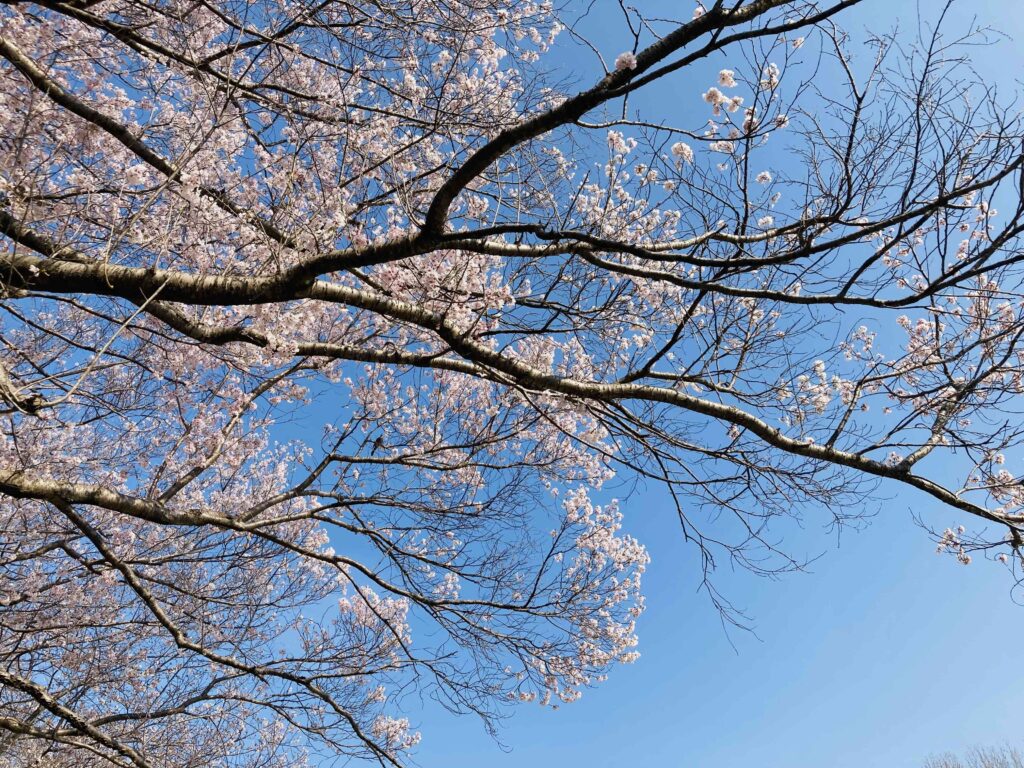
If I had never gone to Thailand, I probably would never have noticed how beautiful Japan’s rivers and skies really are. It felt as if I were Tyltyl and Mytyl, setting out in search of the blue bird.

飛翔いたら 戻らないと言って
目指したのは 蒼い 蒼い あの空Translation:
“Blue Bird” by Ikimonogakari
If I take flight, I’ll never return, I said
What I aimed for was that deep, deep blue sky
Differences in Regulation Compliance Between Japan and Thailand
Air pollution in Bangkok is influenced by many factors, including geography and climate, so it cannot be compared directly with Tokyo. That said, if we look at Japan’s regulations on diesel vehicles, which are a major source of PM2.5 in Thailand, the difference becomes quite clear.
There is a news video from about 18 years ago reporting that after Japan introduced diesel regulations in 2003, the amount of soot in Tokyo’s air was cut in half by 2007:
It would be difficult to implement that kind of rapid and strict regulation in Thailand. One reason is that Thai society itself may not strongly demand such measures.
From an individual standpoint, continuing to drive a diesel vehicle is cheaper and more convenient. There is no need to buy a new car. Even if the Thai government announces tighter regulations, many people may simply continue driving as before, and enforcement may not be very strict.
In Thailand, even when serious environmental issues are visible, policies that go against individual convenience are often not widely desired. In Japan, by contrast, there is a stronger tendency to accept inconvenience at the individual level in order to maintain safety and cleanliness in public spaces.
For example, in Japan, new cars must undergo inspection after three years, and then every two years after that. Because of this system, diesel vehicles that failed to meet regulations could not pass inspection and were removed from the roads. Driving in an illegal condition is rare in Japan, and diesel cars disappeared quickly.
Which “Suffocating” Society Would You Choose?
Personally, I love Thailand’s Mai Pen Rai (no worries / never mind) mindset. Even Japanese people who feel suffocated by their own society sometimes admire that relaxed attitude.
But Japanese people cannot just say Mai Pen Rai, ignoring a situation in which air pollution damages people’s health year after year.
So, which kind of suffocating society would you choose?
To Maintain Safety, Cleanliness, and Order, Individual Selfishness Has to Be Restrained
In Japan, it usually takes several months to get a driver’s license. Regular vehicle inspections also cost tens of thousands of yen each time. Many Japanese people find these systems annoying. Many Thai people would probably see it as irrational to make individuals bear such high costs.
But because of these regulations, and because individuals accept those costs, Tokyo has lower accident rates and cleaner air, in contrast to Bangkok.
The same applies to pouring hot water into instant noodles before paying. From an individual point of view, it may seem “rational” because it saves time. But it can also create risks. Someone could spill the hot water, burn a staff member, or make a mess in the store.
Simply waiting a few extra seconds before adding hot water avoids all of those problems. It also removes the need to argue about responsibility if something goes wrong.
In the end, what counts as “rational” depends on the cultural framework you live in.
Conclusion: Different Cultures Create Different Societies
For Thai people, Japan may feel like a strict and suffocating rule-based society. But those rules also help sustain safety, cleanliness, and order.
Instead of judging another country through your own values, try to understand how that society actually works. That, in itself, may be one of the real pleasures of traveling abroad.
Final Note: The Good Points of Thailand’s “Tolerant” Society
So far, I have focused mainly on the good points of Japan’s strict rule-based society from a Japanese point of view. But Thailand’s “tolerant” society has its own appeals too. In fact, I believe I enjoyed that side of Thai culture very deeply myself. Experiencing both extremes, a “strict” society and a “tolerant” one, has been genuinely valuable for me.
When I was in Thailand, I felt a real sense of freedom. I truly enjoyed my time there and felt alive. If you ask whether I want Thailand to become as strict as Japan, my answer is clearly no. It is a country I love, and if I ever had the chance, I would study abroad there again.
I plan to write about those memories in my next article. By then, however, I hope nobody is still arguing about instant noodles at 7-Eleven.
Because in the end, this is a very minor issue. Mai Pen Rai, Mai Pen Rai.